














HMM and HD KSOE Start Demonstration and Testing of Wing Sail on Tanker
South Korea’s HD Korea Shipbuilding & Offshore Engineering and HMM are starting a demonstration and test period for Korea’s first domestically developed wing sail for wind-assisted propulsion. The shipbuilder has been developing its version of the technology as part of its efforts to advance value-added, green ship designs and technology.
The wing sail was recently installed on the product tanker Oriental Aquamarine (50,000 dwt). The vessel was built in 2020 and has been owned by HMM since 2023. Registered in Liberia, it is 183 meters (600 feet) in length.
Over the next two years, HMM reports it plans to assess the performance of wing sail based on actual operational data and, subject to the results, expand its installation across its entire bulk fleet. The company highlights that the technology is particularly suited to vessels that do not carry deck cargo, such as bulk carriers and tankers. It projects a fuel saving of between 5 and 20 percent with the deployment of wind-assisted technology.
HD KSOE reported in 2021 that it had been awarded an Approval in Principle from DNV as it worked to develop its wind-assisted technology concept for a wing sail. It reports that the design has undergone structural safety and basic performance verification through onshore demonstrations.
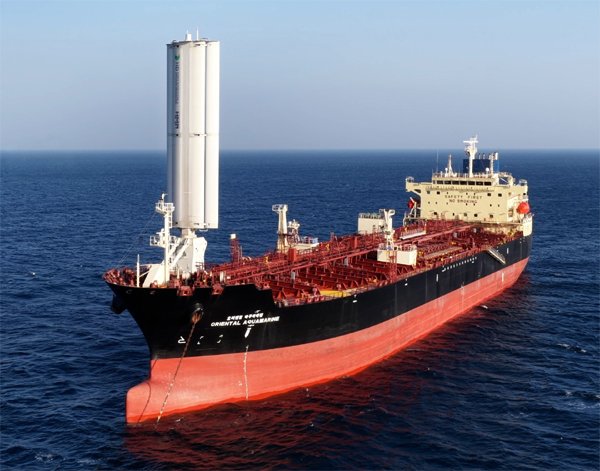
HMM plans to analyze the data as it looks to expand the technology across its fleet (HMM)
The version installed on the MR tanker is 30 meters (98 feet) high and 10 meters (33 feet) wide. In addition to the main sail, it uses auxiliary wings on both sides to enhance utilization efficiency. It also features a tilting function, which allows the wings to be folded during inclement weather or to increase air draft.
The shipbuilder reports that recent sea trials have confirmed normal operation. It has also undergone inspection by the Korean Register. They report that the data from this demonstration will be precisely analyzed to understand the operating characteristics of the wing sail in a real-world marine environment. They expect to use this data to develop commercial models of the technology.

that matters most
Get the latest maritime news delivered to your inbox daily.
Analysts expect wind-assisted propulsion to continue to grow in application as it requires relatively low capital expense and adds incremental fuel and emissions savings. They report that installations are doubling annually, nearing 100 large vessels equipped by year-end.
Content Original Link:
" target="_blank">