














Reports of Closure in the Straits of Hormuz Overstated
A range of international media outlets, some with rigorous collateral information checking protocols, accepted Iranian claims that the IRGC had closed sections of the Straits of Hormuz yesterday (February 17), and reproduced IRGC statements as the version of events. The IRGC cannot be considered a reliable source of information, for example, it regularly passes off historic imagery of previous exercises to illustrate ongoing activity.
The Maritime Executive searched for and found no independent evidence that the IRGC closed sections of the Straits yesterday.
Traffic flows through the northernmost inbound channel - which lies wholly within but on the edge of Omani territorial waters - were lower than normal, whilst traffic on the southern outbound channel remained heavy as usual. This suggests that merchant captains may have heeded warnings and, to avoid any risk, exercised judgment by delaying their transits into the Gulf to avoid the period during which the IRGC had advertised there would be disruption. They could have done this with minimal disruption to costs and liner schedules.
The United Kingdom Maritime Trade Operations (UKMTO) center in Dubai issued no incident reports concerning the Straits of Hormuz over the IRGC exercise period of February 16-17. Nor did CENTCOM, which hinted at what the U.S. response might be to any such closure by posting pictures of a series of heavily-armed fighter jets taking off from the flight deck of the USS Abraham Lincoln (CVN-72). On February 3, an F-35C from the carrier shot down an Iranian Shahed-139 drone that was aggressively approaching the carrier.
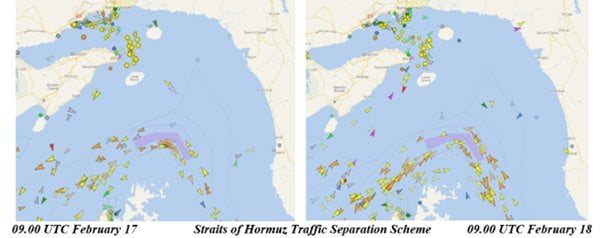
VesselFinder’s plot of inbound traffic during and after the exercise. Traffic continued to use the outbound/southern channel during the early hours of the IRGC exercise, but volumes through the inbound/northern channel were reduced.
In recent weeks, the IRGC Navy has made a number of half-hearted attempts to disrupt traffic in the Straits of Hormuz, largely to support their negotiating position in the ongoing talks between the United States and Iran.
On January 29, the IRGC Navy warned that areas of the Straits of Hormuz would be closed for a live fire exercise. The next day, CENTCOM warned “the IRGC to conduct the announced naval exercise in a manner that is safe, professional, and avoids unnecessary risk to freedom of navigation for international maritime traffic,” and the Iranians then cancelled the planned exercise.
Several days later, on February 3, the United Kingdom Maritime Trade Operations (UKMTO) in Dubai advised that an unidentified ship was hailed on VHF by numerous small armed vessels early and had been requested to stop. This was a poor choice of target for the IRGC to make, as the ship in question was the US-flagged Crowley-managed Stena Imperative (IMO 9666077), chartered under the Department of Defense Tanker Security Program. The master of the ship ignored the request, and the nearby USS McFaul (DDG-74) promptly saw off the threat.

that matters most
Get the latest maritime news delivered to your inbox daily.
The Iranian warning of its impending exercise this week was accompanied by a video showing various IRGC speedboats, but this was historic footage of a previous exercise, and no ships or boats were identified as about to take part in the exercise. The allusion to a ‘smart’ exercise may imply that no actual vessels are involved. An unidentified IRGC Navy Shahid Soleimani Class missile corvette (but likely to be IRIS Shahid Soleimani (FS313-01)) was seen inshore cruising East and alone off Kish Island on February 16. This sighting was consistent with the first day of exercise play, which the IRGC said was focused on the integration of naval assets at sea, coastal defense radars and batteries, surveillance drones, and cruise missiles. But other than missile-equipped speedboats, no other vessels have yet been identified as participants in the now-concluded IRGC exercise.
The IRGC often seeks to exaggerate the threat it poses to the free flow of traffic through the Straits of Hormuz, so as to strengthen its negotiating position. But not only do the IRGC hardliners not follow through, but it is significant that the regular Iranian Navy (Nedsa) is not playing a part in these efforts, and indeed is keeping itself invisible and well out of the way, for the most part by holding off in the northern Indian Ocean. The IRGC appears to hope that social media will pick up and amplify their threats, aiding them in their propaganda efforts by making them more credible than they actually are.
Content Original Link:
" target="_blank">


