














Fresh Thinking for the Strait of Hormuz: the Plan Emerges
The talks taking place in Karachi, from the global maritime community perspective, had one critical issue to resolve: getting the traffic flowing once again through the Strait of Hormuz. Unfortunately, this is not the issue at the top of Iran’s agenda, and the prospects of progress always looked slim. We now know that the talks in Islamabad have collapsed.
Worryingly, Iran presented ‘technical’ reasons why the Strait could not be reopened: they claimed not to know where the mines were, which they have laid, so that a reopening would be delayed pending a mine clearance operation being successfully executed. The Iranians might have thought that this would take some time: there are no apparent conventional mine-clearing resources in theatre now that HMS Middleton (M34) is safely back in Portsmouth and similar American minesweepers have been removed from the Region. Nonetheless, with an admiral in charge with an acute understanding of the importance of maritime trade, US Central Command is likely to have a viable mine clearance plan, contrary to what the Iranians might think. This may involve the US working in particular with nations such as the UK, which have been trailing remote controlled mine clearance systems in the Gulf; experimental systems and those under trial may need to be rushed into urgent operational service.
For those now deciding the next steps, with an obdurate Iran keen to preserve its best bargaining and having failed to use the tool effectively in the talks in Islamabad, the issue must be resolved quickly. For the global economy, and in particular the Gulf states for whom the Strait is a lifeline, there can be no restraints on transit.
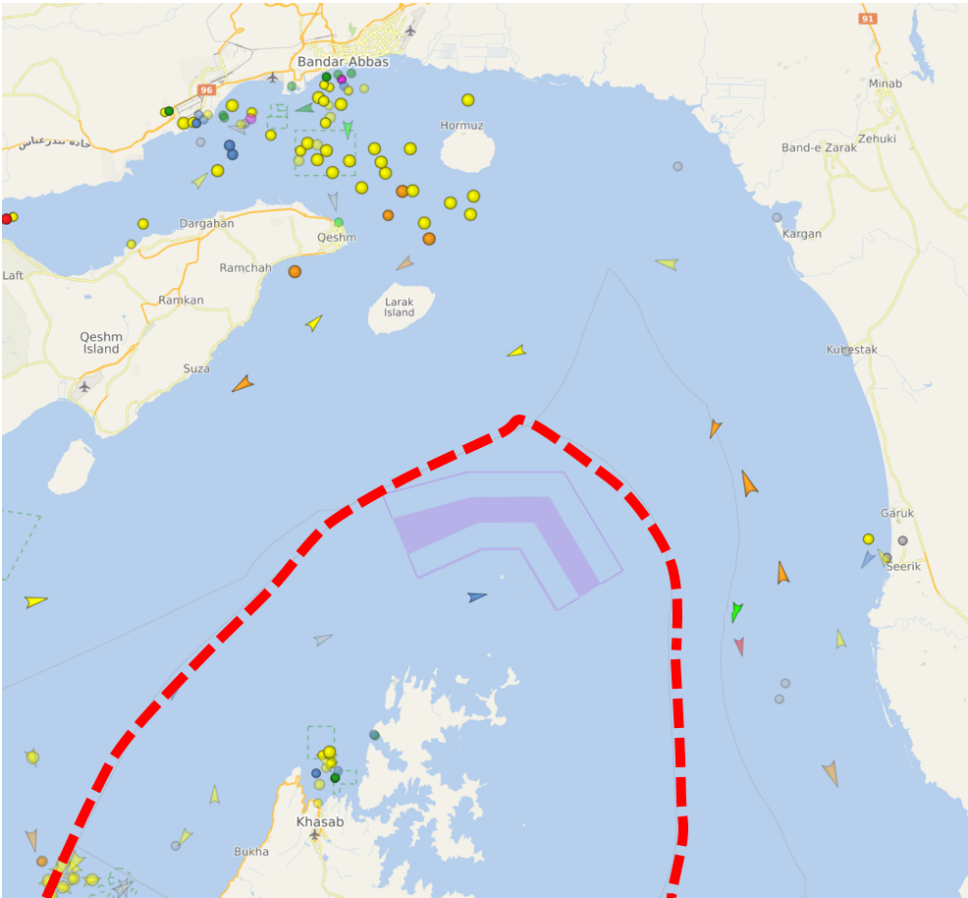
The Straits of Hormuz and the Traffic Separation Scheme empty of ships on April 11, but still with large numbers of vessels at anchor within the Bandar Abbas roads. A small number of vessels are sailing inside Iranian territorial waters, and a few tankers are using the Larak ‘tollbooth’. The only vessel mid-straits in Omani waters is the Bari (MMSI 422330400), a 19m coaster. Omani territorial waters are within the red dashed line. (VesselFinder/CJRC)
The most practical immediate proposal would be to shift the existing Traffic Separation Scheme (TSS) southwards, pushing both the approaches, and the designated inward and outward channels in the narrows, deeper into Omani territorial waters. Currently both TSS channels in the narrows lie in Omani territorial waters, but the northernmost channel runs along the edge of the sea border between Oman and Iran.
Iranian interference with shipping in the Strait has come from small-boat attacks, mining, drones and anti-ship missiles. At present, there is no sea space to interpose a naval screening force between the top of the northernmost TSS channel and Iranian territorial waters. It is easier to defend shipping if naval escorts have some depth, so that there is time and distance to spot hostile incomers, and time to engage them at range rather than as close-in targets. It would not be feasible for the new routes to hug the Omani coast, for navigational and capacity reasons, but it should be possible to move the channels sufficiently further south to generate some sea space between traffic in the new TSS lanes and Iranian territorial waters.
A mine clearance operation, which Central Command clearly has in mind, will need to start with a complete ban on ship movements in the Strait. Without such a ban, there can be no assurance that the Iranians will not lay more mines or interfere with mine clearance operations using small craft. With the US enjoying air power, maintaining a no-ships policy in the Strait would be relatively easy. Such an operation would also deal with a bizarre outstanding policy anomaly: currently, Iranian ships, and ships flagged to nations friendly to Iran or who have paid the regime money for the privilege, are moving through the Strait, earning huge amounts for the regime given inflated oil prices. A closure of this trade would thus also put the Iranian regime under immediate economic pressure.

that matters most
Get the latest maritime news delivered to your inbox daily.
Oman is politically stable and resolutely determined to keep transit through the Strait free for international traffic, under the innocent passage provisions of UNCLOS. It stood recently for election to the Council of the International Maritime Organisation, espousing these principles, falling short of gaining a seat by three votes – many may now be regretting not having voted for Oman in consequence. A new arrangement, nudging sea traffic further from the possibility of Iranian interference, might improve the prospects of safer transits. But Oman would have much rather a peaceful solution had been found in the Islamabad talks. It would be loath to see any conflict in its waters, or even worse, spilling onto its own territory.
The passage on April 11 westwards through the Strait, followed by an immediate return eastwards by two US Navy Arleigh Burke Class guided missile destroyers USS Frank E. Peterson (DDG-121) and USS Michael Murphy (DDG-112) is an encouraging first sign that Central Command’s plan is rolling into action. Both destroyers must have successfully plotted courses through what might have been considered to be mined sea area. The next step is likely to be an enforced closure of the Strait, and the removal from the Strait of shipping both at anchor and in transit, so that an effective mine-clearing operation can get underway.
Content Original Link:
" target="_blank">


