














USCG Storis Completes Winter Bering Sea Deployment as Commissioning Proceed
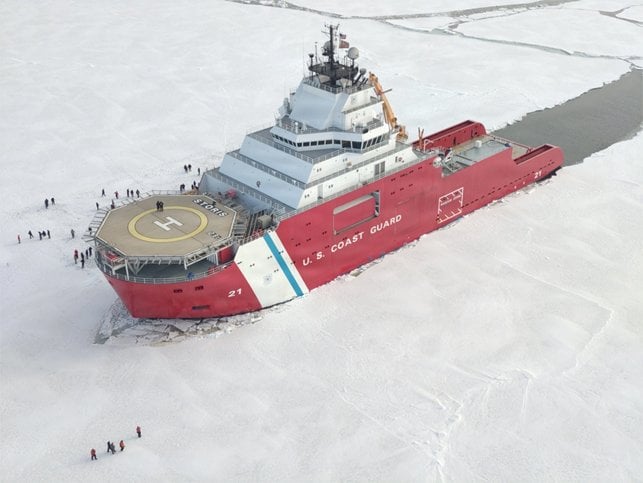
The U.S. Coast Guard is highlighting that its newest polar icebreaker, USCG Storis, completed a grueling 36-day deployment to the Bering Sea during harsh winter conditions as the crew training and commissioning of the vessel continue. She returned to her homeport in Seattle on May 11
Commissioned in 2025, Storis is the first polar icebreaker added to the Coast Guard in more than two decades. Originally built for commercial operations, Storis is a 360-foot medium icebreaker with a displacement of nearly 15,000 tons. Powered by four diesel engines generating 22,500 horsepower, the cutter can navigate through three feet of ice at five knots, adding crucial capability to the Coast Guard’s Arctic operations.
The vessel is continuing its commissioning with further alterations still underway to adapt her from commercial operations to meet the needs of the USCG. She will eventually be moved to a homeport in Alaska once the base is completed and she has undergone her conversion and crew training.
The USCG reports the patrol focused on advancing operational readiness, strengthening interoperability with other military assets, and testing new concepts to support prolonged operations in one of the world’s most demanding and austere maritime environments. The crew evaluated the cutter’s full icebreaking capabilities, with data gathered serving as a benchmark to inform future operations for U.S. and allied vessels navigating high-latitude environments.
“Operating the Storis in the extreme conditions of an Arctic winter is a clear statement of our nation’s resolve,” said Capt. Corey Kerns, commanding officer of Storis. “Storis represents a critical bridge to our future icebreaker fleet. This mission is about preparation, rigorous training, and asserting the continued importance of the Arctic to our nation.”
To demonstrate U.S. operational capability in the high latitudes, USCG highlights that Storis conducted a joint passing exercise with the Legend-class national security cutter USCGC Waesche. The exercise took place in challenging winter conditions less than a mile from the ice edge, with visibility limited to 150 yards. Storis and Waesche also executed a proof-of-concept fueling exercise in Dutch Harbor, Alaska. According to the Coast Guard, by establishing cutter-to-cutter refueling capability, Storis can extend an asset’s time on station, maximizing operational reach while reducing the need for long transits back to port for logistics.
The crew also conducted advanced ice rescue training during the deployment, practicing complex life-saving maneuvers in unforgiving Arctic conditions. The crew also conducted a gunnery exercise.

that matters most
Get the latest maritime news delivered to your inbox daily.
Storis, built in 2012, was acquired from Edison Chouest at the end of 2024 to expand USCG’s capacity beyond the aging cutters Healy and Polar Star and to augment the Coast Guard’s presence in the high latitudes. She will provide a key capacity while the Coast Guard waits for the delivery of the first of its newly ordered vessels, expected in 2028. The much-delayed first heavy icebreaker is now due in 2030 as a replacement for the now 50-year-old Polar Star.
USCGC Storis is expected to permanently homeport in Juneau, Alaska, around 2029.
Content Original Link:
" target="_blank">