










Op-Ed: Chinese Drills Near Taiwan Aren't a Signal
[By Nathan Attrill]
Analyzing China’s military activity around Taiwan often invites a simple question: what triggered it? Analysts tend to assume that spikes in aircraft sorties, naval deployments or coast guard operations must be a reaction to something political in Taiwan, US actions in the region or other international events.
But a close examination of 2025 data complicates this assumption. Domestic rhythms inside China—holiday cycles, political security priorities, command availability—shape operational tempo more reliably than events in Taipei or Washington.
Put simply, the scale and persistence of Chinese military activity around Taiwan look less like signalling and more like systematic preparation for the use of force, conducted on Beijing’s own timetable.
A review of military coercion data compiled throughout 2025 for ASPI’s State of the Strait—a weekly newsletter tracking Beijing’s coercion of Taiwan—highlights several striking patterns. First, true absences of Chinese military activity around Taiwan are vanishingly rare. Across the entire year, there were only two days—12 and 13 November—when no Chinese military air or maritime assets were detected around Taiwan. This underscores how deeply normalized Chinese military presence has become. Activity levels may rise or fall, but presence itself is now continuous.
Second, even while China’s military has become far more comfortable operating in poor weather, environmental constraints still matter. Air and maritime activity dropped noticeably during typhoons affecting the Taiwan Strait, including Danas, Podul and Ragasa. This confirms that even highly normalized pressure campaigns remain subject to safety and risk management of Taiwan’s typhoon season (June to November).
Third, Chinese military activity tends to dip during Chinese holiday periods and sensitive internal political moments. Chinese holidays, which usually last several days, and the fourth plenum of the Chinese Communist Party were all associated with lower observable activity.
More revealing, however, is what doesn’t show up clearly in the data. In many cases, there was no obvious connection between Taiwan-related events, US actions or international developments and subsequent increases or decreases in Chinese military activity. Days of elevated activity often occur without any clear external trigger. Conversely, politically salient events frequently pass without a discernible military response. This challenges the common analytical reflex of searching for one-to-one causal explanations.
Indeed, some of the most intense periods of Chinese military activity in 2025 were preceded not by provocation, but by noticeable lulls. Both Operation Strait Thunder and Justice Mission followed periods of relatively subdued activity. Their justifications—couched in broad language about sovereignty, deterrence and readiness—were boilerplate and non-specific. Given the complexity of joint operations, force mobilization and coordination across services, it is highly unlikely that either was triggered by a discrete Taiwanese or foreign action in the days immediately prior. The more plausible explanation is that both were executed according to internal readiness cycles and training schedules.
Electoral dynamics reinforce this interpretation. One might expect Beijing to modulate pressure in ways that favor preferred political outcomes in Taiwan. Yet Chinese military activity did not noticeably decline ahead of Taiwan’s July or August recall elections, despite the assumption that Beijing would want to avoid alienating voters and harming the Kuomintang’s prospects. The absence of adjustment suggests two things: first, that Beijing either doubts its ability to influence Taiwanese voter behavior through calibrated restraint; and second, that the Chinese military’s operational schedule takes precedence over tactical political messaging. The data suggests a tacit conclusion in Beijing that Taiwanese voters are no longer meaningfully swayed by fluctuations in Chinese military presence because that presence has become normalized.
Other patterns further support a structural explanation. High-altitude balloons, for example, appeared regularly only in the first quarter of the year. This seasonality points to atmospheric conditions and sensor-testing cycles rather than political intent. Similarly, the overall distribution of activity suggests that the Chinese military is not working to externally imposed timelines. There is no requirement to respond quickly to events abroad. Instead, the Chinese military operates on its own timetable and risk assessments, constrained by weather, holidays, training phases and readiness objectives.
This aligns closely with what has been observed since 2020. While Beijing does sometimes use military activity as a signalling tool, especially after high-profile diplomatic events, much of what appears to be signalling is better understood as ‘opportunistic justification’. Planned exercises are hurriedly or retroactively framed as responses to external developments, providing political cover rather than genuine causation. As Chinese military operations around Taiwan have become more routine, the signaling function has diminished relative to training, testing and familiarization.
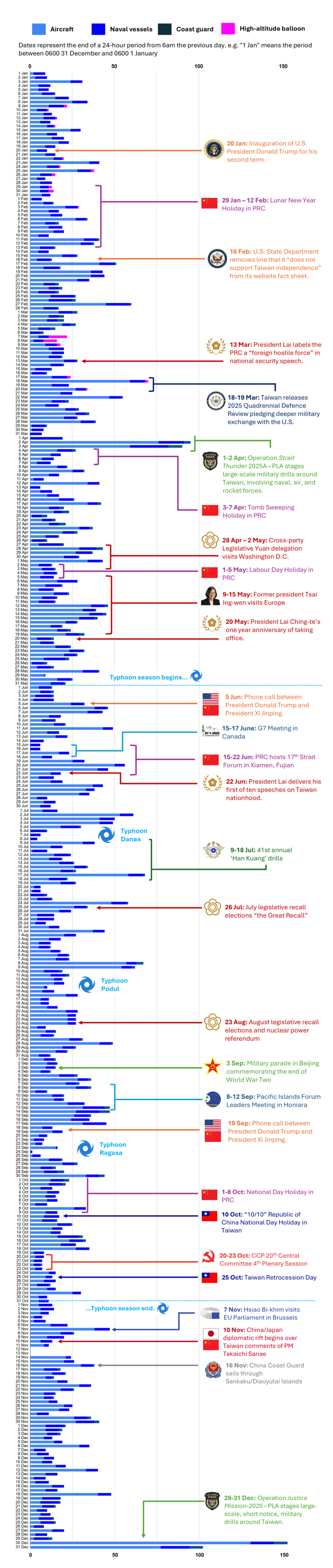
China’s military activity around Taiwan and selected events in 2025. Source: Nathan Attrill/ASPI.
Earlier years illustrated this shift clearly. Between 2020 and 2022, Chinese military activity was more episodic and easier to link to discrete events. By 2023 and 2024, those links weakened as median-line crossings, eastern-flank operations and joint drills became standard practice. By 2025, the system appeared largely decoupled from external calendars. The Chinese military is preparing for contingencies on its own terms, not reacting tactically to each political development across the Taiwan Strait.
The analytical implication is significant. Attempts to attribute daily Chinese military activity to specific world events risk over-interpretation and confirmation bias. While political context still matters at the margins, the dominant drivers in 2025 were internal: force readiness, training cycles, environmental conditions and institutional schedules. Beijing does not need an excuse to operate around Taiwan and, increasingly, it does not bother to provide a convincing one.
In short, military coercion around Taiwan in 2025 reflected preparation, not provocation. The absence of clear causal links is not a failure of analysis—it is the point.
Nathan Attrill is a senior analyst at ASPI Cyber, Technology and Security program.

that matters most
Get the latest maritime news delivered to your inbox daily.
AI contributed no ideas to this article—Nathan Attrill.
This article appears courtesy of The Strategist and may be found in its original form here.
Content Original Link:
" target="_blank">