














Asia Looks to Regional Approach and Diversity to Accelerate Cruise Growth
While enjoying strong growth in the cruise sector, Asia has still been slow to rebound from the COVID-19 pandemic compared to other regions. The prevailing view is that the market needs to better educate both the cruise lines and travelers, and through a regional approach, it can overcome some of the challenges that linger for the region.
Pre-pandemic, China was the second-largest source market for cruising, according to data from the trade group CLIA (Cruise Lines International Association), but it fell to number seven in 2025, despite nearly 16 percent growth. Similarly, Asia overall surpassed three million passengers in 2025, with a growth rate twice that of North America, making it the fastest-growing region, but the market was at just 71 percent of its 2018 peak, while elsewhere in the world, cruising set all-time records in 2025.
Experts point to many challenges, including geopolitical issues that are impacting the Asian cruise market. Dickson Chin, Managing Director of Wallem Ship Agency, also points out that Asia was slow to reopen after the pandemic, and specifically, China was the last market to restore international cruise travel. Chin believes cruise lines committed tonnage to other markets, which have produced strong results, delaying a return to Asia.
“Asia isn’t just my home; it’s where my (admittedly biased) belief runs deepest: this is the world’s most exciting, ripe-for-growth cruise region,” wrote Chin at the close of the Seatrade Cruise Global 2026 conference last month. He, however, notes, “For too long, we have fragmented into North Asia and Southeast Asia.”
He points to the opportunity to “piece together” and sell as a regional destination. “We need to educate about the market,” says Chin. He points to the diversity of the region and the experiences it can provide. The availability of experiences in Asia aligns with global travel patterns that show travelers are placing the highest priority on unique experiences. It presents a marketing opportunity for the countries and their tourism organizations to work together.
Wallem, which has a 123-year heritage in Asia, provides a broad range of services, including ship agency as well as ship and crew management. It reported a record year in 2025, but Chin points to the exciting opportunities for the market. They are especially encouraged by the arrival of Disney with the show-stopping 208,100-gross ton Disney Adventure based year-round in Singapore. At the other end of the spectrum in the market, the ultra-luxury Luminara of The Ritz-Carlton Yacht Collection offered her first cruises in Asia as the line looked to expand in the region.
Tourism executives in Singapore point out that the Disney Adventure, which can accommodate approximately 6,700 passengers, has the prospect of handling 500,000 passengers annually and is committed to homeporting in Singapore for at least five years. In 2025, Singapore welcomed over two million cruise passengers, an increase of more than nine percent from the previous year.
Similarly, executives in Japan’s tourism industry are anxiously awaiting the arrival of a Disney cruise ship under a licensing agreement with Oriental Land, the operator of the Tokyo Disney Resort. Japan has set a target to grow its cruise industry from its current 250,000 passengers to one million passengers by 2030, in large part with the arrival of a Disney-branded cruise ship.
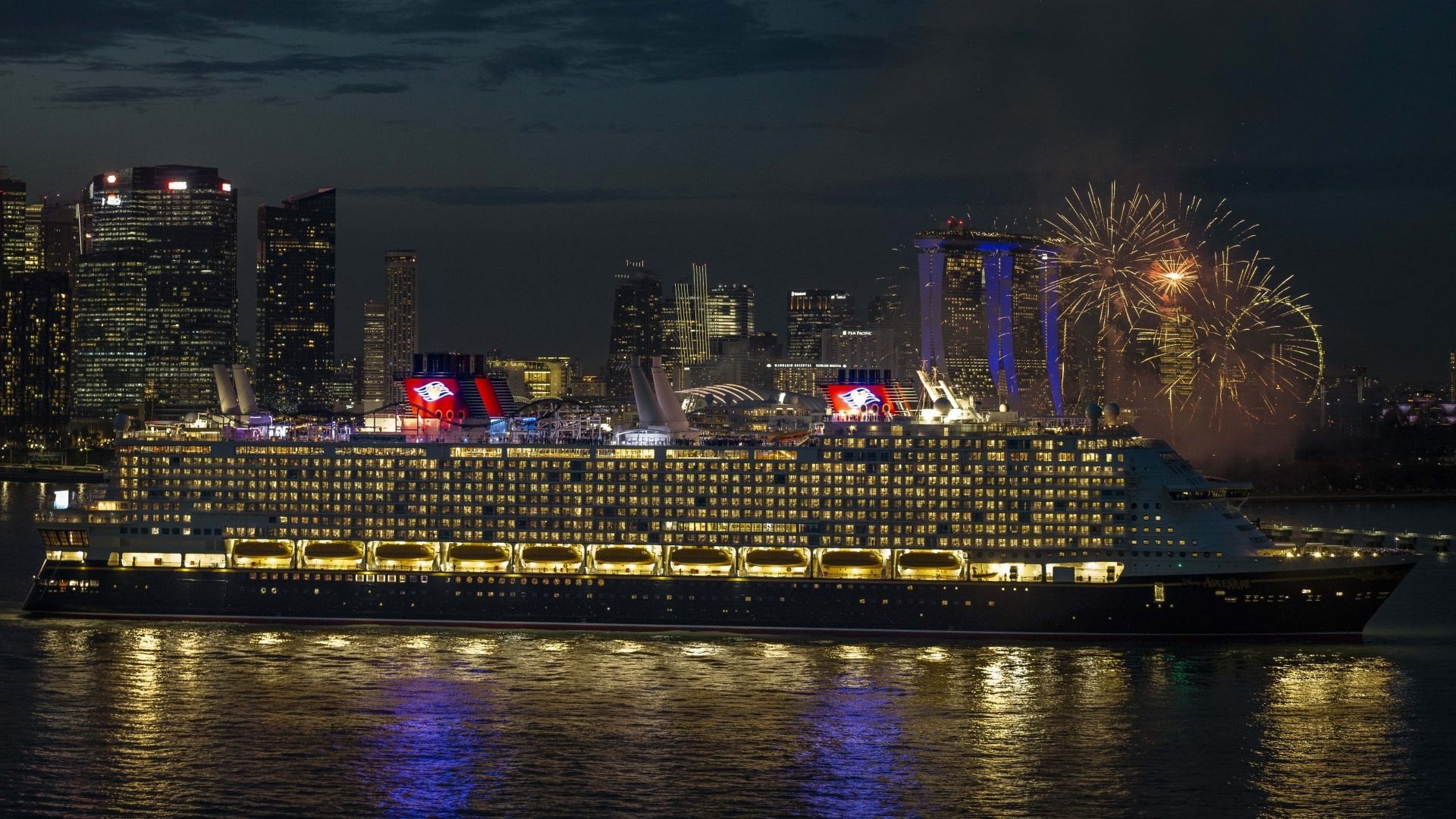
Disney Adventure arrived in Singapore in March, creating additional excitement in the Asian markets (DCL)
“Governments in Asia are not shy about investment,” notes Chin. He points out that the governments have invested in terminals and infrastructure to attract more ships, whereas in other parts of the world, the investments only come after the ships are already in the market. Wallem has been working with South Korea, where Chin highlights the country has grown from five to nine ports prepared to handle cruise ships. Similarly, they are working with ports in Japan, where they see the opportunity to create diverse experiences by visiting a series of ports.
Wallen points to other opportunities that it is exploring that can offer cruise lines unique experiences. For example, it is discussing with Hong Kong officials reopening anchorage opportunities for the cruise ships, which would not only save on dockage/wharfage fees and address berth capacity issues but also provide unique experiences. Chin points to the opportunity to tender passengers to the UNESCO World Heritage sites and Hong Kong’s Marine Park.
To develop the regional opportunities, Chitra Rajesh Kuman, Director for Cruise at the Singapore Tourism Board, highlights that it has formed a task force with Thailand. The board is also sponsoring the first-ever Asia Cruise Investment Forum 2026, which will be taking place in Singapore later this year to expand the discussion on cruise opportunities in the region.
China, however, remains one of the most challenging markets. While the market showed strong, 28 percent growth in the first 11 months of 2025, it remains price-competitive and lacks a developed marketing infrastructure.
China Merchants, after five years, decided to end its joint venture, and Viking has reclaimed its cruise ship, Yi Dun. Smaller brands, including Blue Dream, suspended operations while the cruise ship Piano Land is heading to a new Spanish company. Built in 1995, the ship has passed the 30-year age limit imposed by the Ministry of Transport for ships to operate from mainland China.
Education remains one of the challenges for the Chinese consumer. Their expectations for cruising are different from Americans and Europeans. Chinese travelers reportedly want an “integrated resort approach,” family fun, and abundant entertainment. They still look at cruise ships as a means to reach destinations, attracted by the overseas shopping opportunities.
There are, however, hopeful signs for the Chinese and broader Asian markets. Cruise stopovers by international lines operating cruises to Asia are on the increase. Both Royal Caribbean International and MSC Cruises have also positioned ships year-round in China as the first international companies to reopen the homeports. Royal Caribbean recently told investors it has seen growing sales volume for its longer Asian cruises and increasing per diems.

that matters most
Get the latest maritime news delivered to your inbox daily.
Adora Cruises reports its second, domestically-built cruise ship will be delivered on November 6, approximately two months ahead of schedule. The Adora Flora City will enter service on November 22, sailing from the Guangzhou Nansha International Cruise Home Port. It will be Adora’s third cruise ship, and the company has already signed an order for two Chinese-designed cruise ships and has an option for a third. It expects to introduce the first of these ships by the end of 2030.
While Asia was slower to rebound from the pandemic than other geographies, analysts and industry participants believe it continues to have strong untapped potential that will drive its future growth.
Content Original Link:
" target="_blank">