








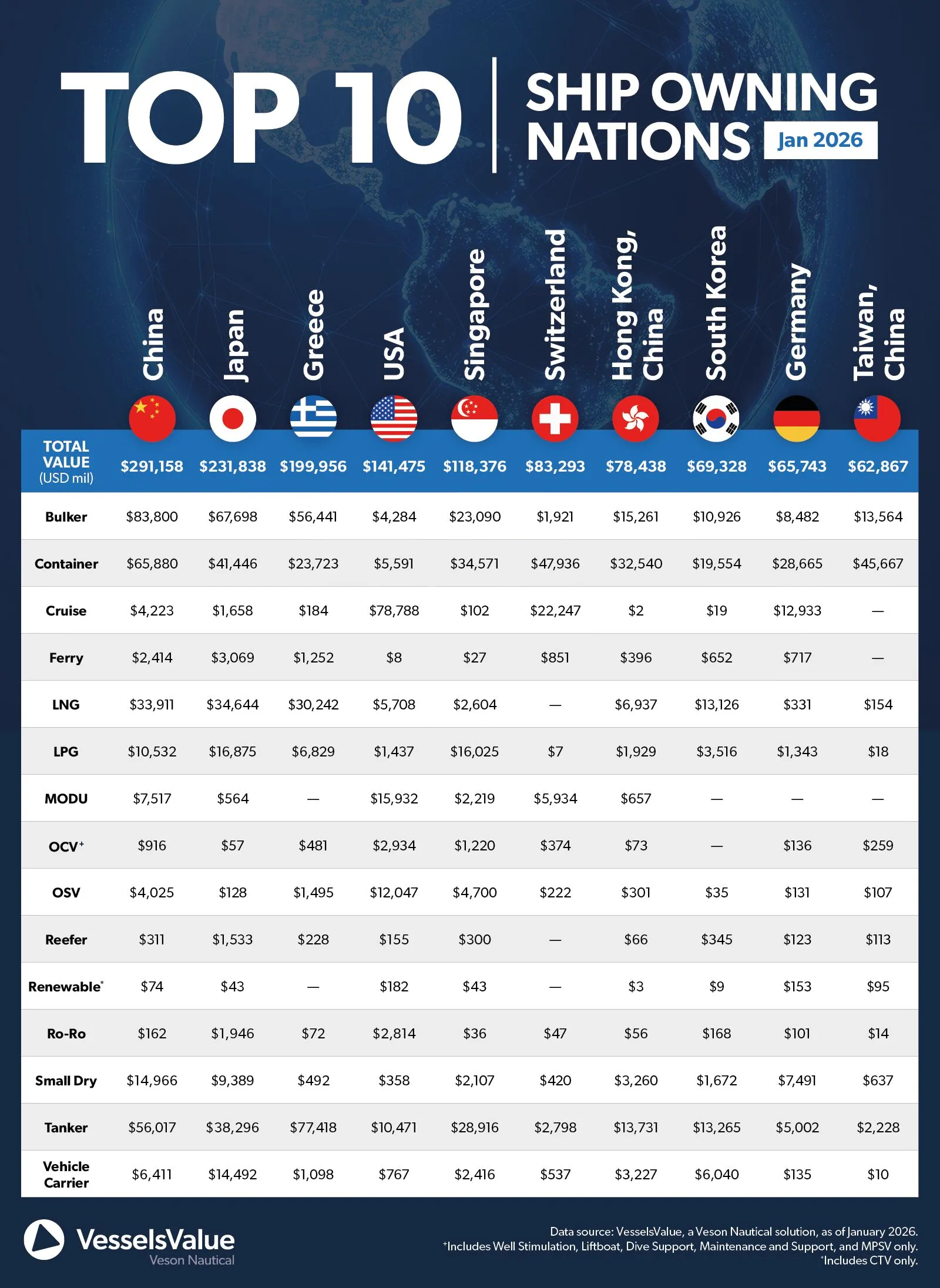
Top 10 shipowning nations by total asset value in 2026
The 2026 ranking of the world’s top shipowning nations by total asset value highlights how container shipping has become a central driver of fleet value growth, reshaping the balance of power among leading maritime countries.
According to the latest Veson Nautical report, covered by VesselsValue, container vessels, both in operation and on order, are playing a decisive role in changes to the top 10, particularly through large-scale fleet expansion, rising asset values for older tonnage, and aggressive newbuilding programmes in the ultra-large and New Panamax segments.
China remains dominant, driven by container and bulker values
China has retained its position as the world’s largest shipowning nation, with total fleet assets valued at USD 291 billion across 9,375 vessels. Container shipping is a key pillar of this dominance. China owns the most valuable container fleet globally, supported by rising asset prices across the sector.
Older container vessels have seen notable appreciation, with 15-year-old Sub-Panamax ships of around 2,500 TEU gaining more than 18% year-on-year. This asset value recovery has reinforced China’s leadership in both vessel numbers and capital value.
Japan and Greece hold steady
Japan remains second overall with a fleet valued at USD 233 billion, though its strength lies in Containers, LNG and Bulkers. In third place, Greece remains a global leader in tanker values, with container shipping contributing only marginally to its position.
United States retains fourth place driven by cruise
The United States remains in fourth place among the world’s shipowning nations, with a total fleet value of USD 141 billion, an increase of more than USD 25 billion compared with the previous year. The country’s maritime asset base continues to be dominated by the cruise sector, which accounts for USD 79 billion in value, up by approximately 34% year on year, reinforcing the US’s global leadership in cruise shipping.
Singapore and Switzerland: asset growth driven by scale and container expansion
Singapore has retained its position among the top five shipowning nations, with total fleet value rising by more than USD 34 billion year on year to USD 141 billion, supported by a large and diversified fleet of 3,359 vessels. While its strength remains in LPG and offshore segments, Singapore continues to benefit from broad-based asset appreciation across sectors.
Switzerland, meanwhile, has emerged as one of the fastest climbers in the rankings, moving up to sixth place with fleet value reaching USD 83 billion. This surge is overwhelmingly container-led, driven by MSC’s aggressive secondhand acquisitions and a heavy orderbook of ultra-large and New Panamax container vessels contracted at Chinese yards for delivery between 2027 and 2030.
Container ships anchor Hong Kong’s return to the top 10
Hong Kong, China has entered the top 10 in seventh place with a total fleet value of USD 78 billion. Containers form the backbone of the fleet, representing USD 32.5 billion in asset value, followed by bulk carriers at USD 15.3 billion and tankers at USD 13.7 billion. Hong Kong also maintains a strong LNG presence, with LNG fleet assets valued at USD 6.9 billion, ranking fifth globally.
South Korea holds eighth place on LNG and vehicle carrier strength
South Korea has slipped two positions to eighth place, although total fleet value remains stable at USD 69 billion. The country continues to benefit from its strong exposure to LNG shipping, ranking fourth globally with fleet value of USD 13 billion, despite a year-on-year decline. South Korea also remains a major vehicle carrier owner, with assets valued at USD 6 billion.
The recent acquisition of approximately 35 VLCCs by Sinokor is expected to add around USD 2.8 billion to fleet value once ownership transfers are completed, without affecting rankings.
Germany remains a container specialist despite lower asset values
Germany has moved up one place to ninth, continuing its long-standing focus on container shipping. German owners control the world’s second-largest container fleet by vessel count, totaling 586 ships. In value terms, however, the container fleet ranks sixth globally, with assets valued at USD 29 billion, reflecting Germany’s emphasis on ownership scale rather than ultra-large or high-value tonnage.
Taiwan enters top 10 on modern, high-value container fleet
Taiwan, China rounds out the top 10 with a total fleet value of USD 63 billion across 1,297 vessels, displacing Norway from the rankings. Container shipping is central to Taiwan’s position, with its container fleet ranking third globally by value, despite placing only sixth by vessel count — an indication of a modern, high-capacity fleet.
In 2025 alone, Taiwanese owners ordered 63 container vessels, including 25 New Panamax and ULCV units placed by Evergreen Marine, scheduled for delivery between 2027 and 2029.
Content Original Link:
" target="_blank">


