














Massive $1.6 billion long positions liquidated! Bitcoin suddenly plunges towards $75,000: Is the 'digital gold' myth fading?
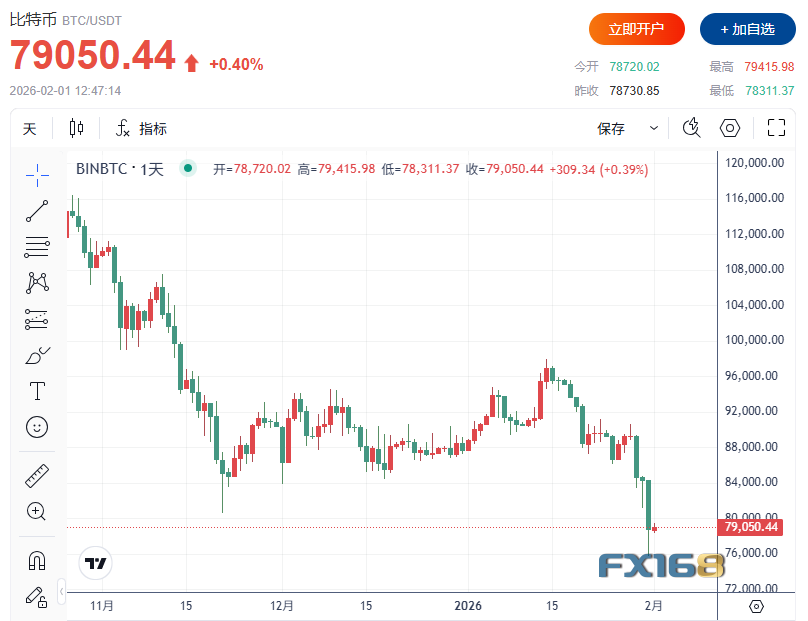
FX168 Financial News Agency (North America) reported that the cryptocurrency market experienced a new wave of selling pressure on Saturday (January 31). The price of Bitcoin fell below $80,000 for the first time since April due to continuous outflows from ETFs, massive liquidations of long positions in futures, and the shadow of another potential U.S. government shutdown, significantly increasing market panic.
On Saturday, the price of Bitcoin dropped below $80,000 per unit for the first time since April. Bitcoin once fell to $75,773, with a daily decline exceeding 8%; since the beginning of this year, it has fallen nearly 13%.
(Source: FX168)
 Over a longer period, Bitcoin has fallen more than 11% in the past week; year-to-date, it is also down about 11%.
One of the contributing factors to this decline is the continued withdrawal of funds from U.S. Bitcoin spot ETFs. Data from Farside Investors shows that investors withdrew nearly $1.5 billion from U.S. Bitcoin ETFs this week.
These funds are managed by institutions such as BlackRock, Fidelity, and Grayscale, providing investors with convenient exposure to Bitcoin prices.
Another factor driving the price drop comes from the chain reaction in the derivatives market. According to Coinglass data, within the past 24 hours, approximately $1.6 billion worth of positions in the futures market were forcibly liquidated.
The vast majority of these were long positions—traders betting on further increases in digital assets. This indicates a typical 'panic-driven deleveraging' during the decline, further amplifying volatility.
Reports indicate that ETF outflows have accelerated in recent weeks due to geopolitical concerns and the risk of a U.S. government shutdown. A partial government shutdown occurred on Saturday, but markets generally expect it to be short-lived. Trump stated this week that he would cooperate with Democrats to avoid a prolonged shutdown.
However, it is worth noting that last year's shutdown had hit cryptocurrency asset prices, followed by sluggish recovery. Meanwhile, earlier this week, declines in tech stocks also dragged down Bitcoin—the cryptocurrency market has shown stronger co-movement with U.S. equities since last year.
In addition to Bitcoin, Ethereum's decline was even sharper, trading at around $2,401 on Saturday, with a drop exceeding 12% over the past 24 hours.
Other mainstream cryptocurrencies also came under pressure: XRP fell by about 10%, while Solana dropped approximately 11%.
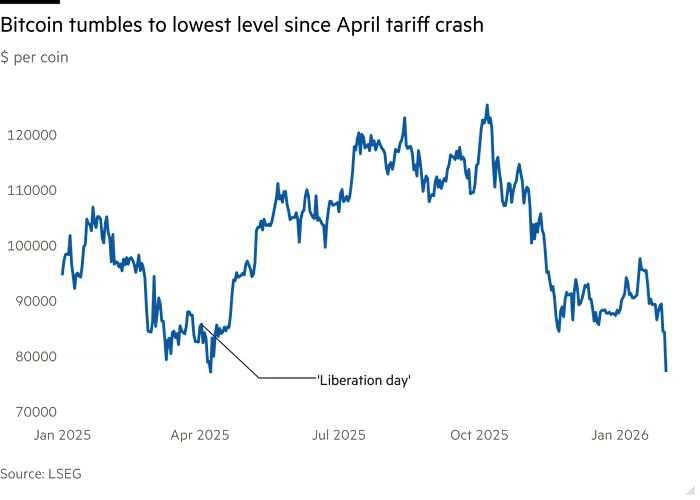
Is the 'digital gold' myth collapsing? Bitcoin has fallen to its lowest level since the tariff shock, as safe-haven funds shift toward physical gold.
The price of Bitcoin has dropped to its lowest level since last year's 'tariff shock,' and its reputation as 'digital gold' is unraveling.
(Source: LSEG)
This movement comes as gold and other precious metals have surged strongly driven by 'safe-haven buying'—amid rising geopolitical tensions and tariff threats, investors have flocked to traditional safe-haven assets. Gold recently hit a new all-time high, surging 23% and briefly exceeding $5,600 per ounce, but retreated sharply on Friday to around $4,800.
For a long time, cryptocurrency advocates have referred to Bitcoin as 'digital gold,' considering it a virtual version of precious metals and claiming it to be a safe-haven asset during times of stress.
However, Ilan Solot, Senior Global Market Strategist at Marex Solutions, stated that Bitcoin 'is an asset still searching for a valuation model,' adding that 'the market lacks clear consensus on what should drive its price.'
Pramol Dhawan, Managing Director at Pimco, argued that Bitcoin's 'digital gold narrative' has 'vanished,' and this downturn indicates it 'is not a monetary revolution.'
At the end of last year, Bitcoin reached a historic high near $125,000 amid investor enthusiasm over a series of President Trump's 'pro-crypto' measures. These included appointing more crypto-friendly regulators, halting enforcement actions against crypto companies, and passing landmark stablecoin regulations.
Since then, however, the price of Bitcoin has continued to decline. Other tokens, including Ethereum and Solana, have also seen significant pullbacks from their peaks last year.
Trump's tariff threats, his claim regarding 'taking over Greenland,' and broader geopolitical tensions with Iran and Venezuela have prompted investors to rush into gold and silver; yet traders view crypto assets as more 'risky' investments.
A crypto venture capitalist remarked, "Bitcoin is increasingly being tied to the current administration." He added that Bitcoin is paying a price for its association with the Republican political party.
Analysts at crypto research firm Kaiko wrote, "The correlation between Bitcoin and gold is inherently unstable, oscillating between strong positive and negative correlations depending on prevailing macro narratives. The volatility triggered by tariffs has exposed Bitcoin's ongoing identity crisis."
Solot also noted that early adopters of Bitcoin did believe in the 'digital gold' narrative, but as institutional investors have entered en masse, it is no longer entirely driven by philosophical conviction.
He added, "It's more like a stress test of an old-school perspective, and the results are not as expected."
He further stated that retail traders’ excitement has increasingly shifted toward prediction market platforms such as Polymarket and Kalshi.
Prediction markets are platforms that allow people to bet on events, such as who will be the next Federal Reserve chair or who will win the Australian Open. Recently, these platforms have gained significant popularity.
He added that platforms like Hyperliquid are also gaining more attention within the crypto community. For larger institutional investors, the rise of crypto perpetuals and digital asset treasury companies is 'diverting funds and focus,' reducing capital concentration purely on Bitcoin.
Content Original Link:
" target="_blank">