







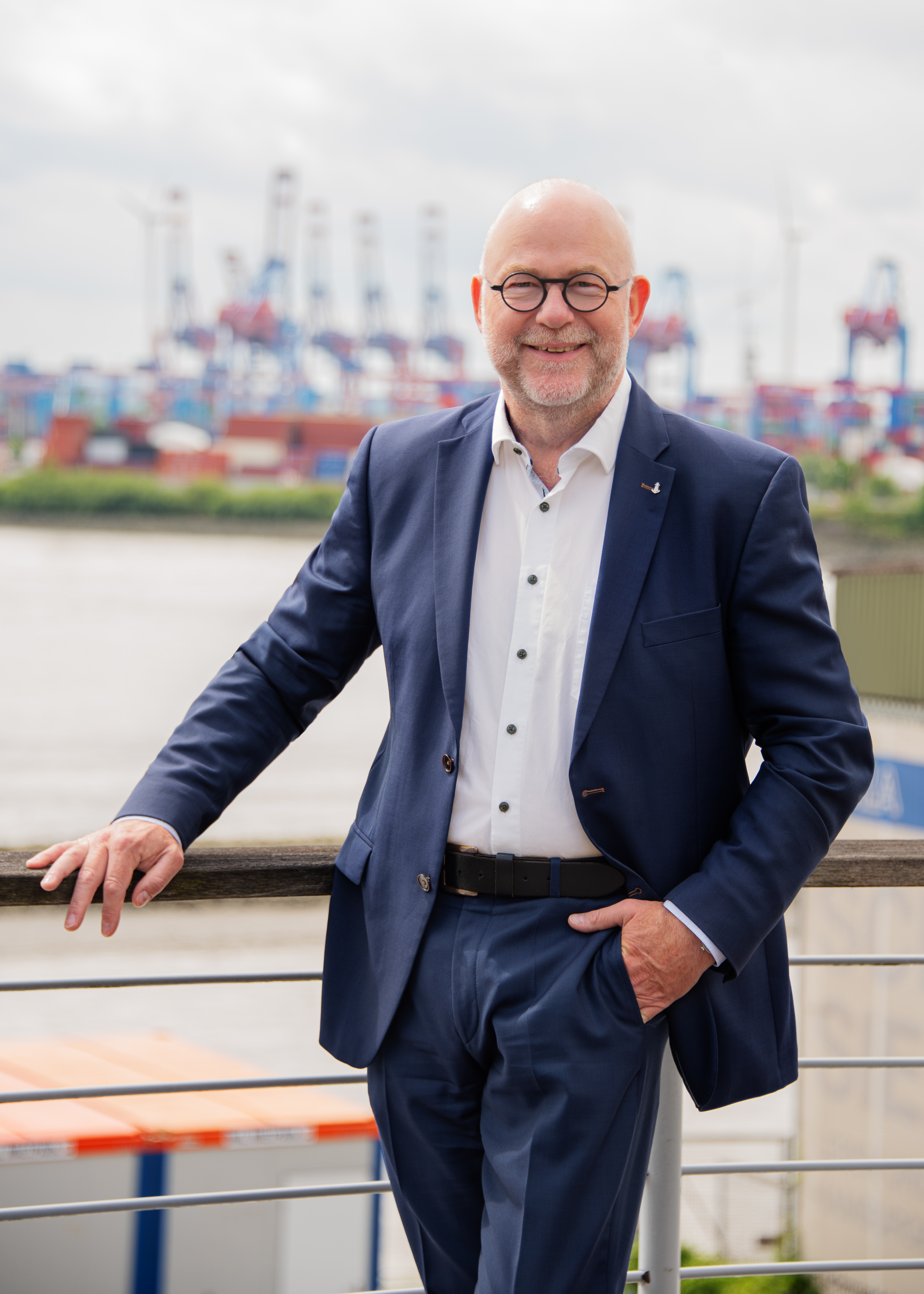
Interview with Axel Mattern, CEO, Port of Hamburg Marketing


In this exclusive interview, Container News Journalist Antonia Saratsopoulou speaks with Axel Mattern, CEO, Port of Hamburg Marketing. Mr Mattern discusses how the Port of Hamburg is leveraging its unmatched connectivity to the European hinterland, pioneering “smart port” technologies, and investing in sustainable infrastructure to remain a preferred hub for global shipping lines and businesses alike. From rail-first logistics solutions and digitalization initiatives to green shipping corridors and international collaboration, Hamburg offers a glimpse into the future of maritime trade, one that balances efficiency, resilience, and environmental responsibility.
How is the Port of Hamburg driving its growth in today’s competitive market?
It’s very complex because we have aspecial worldwide situation where we are in.
But Hamburg is well prepared in terms of infrastructure, prepared of reachability. And of course, the main point for Hamburg is the connectivity to the hinterland and to the hinterland market. To the clients, the companies in the European hinterland, which are importing and exporting, that’s quite a special situation because it’s very sustainable and very reliable due to the rail connection from and to the port of Hamburg.
What are the main competitive advantages that distinguish Hamburg from other major European ports such as Rotterdam or Antwerp?
We are all serving the same European main market, but Hamburg is first of all quite deep geographically situated in the hinterland already because we are quite 100 kilometres from the open sea in the hinterland.
We are surrounded by a metropolitan region which is very important for Hamburg and the port’s connectivity. Also, Hamburg is the biggest European rail port.
More than 50% of the cargo being transported from and to the port is being transported by rail. So that’s our biggest advantage, because that’s a very reliable and sustainable connectivity for the clients in the market.
The Port of Hamburg is often referred to as a “smart port.” Could you share some of the latest technological innovations being implemented, and how AI, and automation are being leveraged to enhance efficiency, resilience, and overall performance?
Hamburg started quite early being a smart port and living this idea of smart ports. So, connecting everything which is in the port, if you take the example of data communication system, that was already established in the Port of Hamburg in the early 80s.
Also, in the early 80s the Port of Hamburg started a data communication system, in a very rural but digital way.
And so, the digitalization of port and data communication started in the early 80s. It is a long time already, fully paperless and already also completely includes the customs, the veterinarian and all the dangerous codes.
Everything is digitalized in the Port of Hamburg for years. Especially connecting the stakeholders in the port, has been a duty long ago.
Additionally, not only logistics and infrastructure connecting together, but energy and using energy from industry. And that’s very smart because when you have production in the port you can use the heat or the water or whatever is being produced from this industry for the grid or for others in the port in order to be perfectly connected.
So, Hamburg started very early to be a smart port and it’s a kind of front runner in that respect.
How is the port preparing for the growing demand for alternative fuels and green logistics corridors?
We are very active and have already established several green shipping corridors and memorandums of understanding use with shipping lines with other ports. The port has already started to be prepared in order to be able to supply all these different stuff.
For the port it’s quite complex because of its infrastructure, meaning you must build something without having a business case in upfront. So, the port of Hamburg and especially the city of Hamburg made the first step.
Today we have nearly every berth connected with onshore power supply, and that’s there we have front runner in Hamburg.
We are trying to be able to supply each and every alternative fuel and whatever may come, even if it’s just in small portions right now.
Are there any major collaborations or investments planned to strengthen Hamburg’s position as a hub for intermodal transport?
First of all, we have several partnership agreements within the port.
We have terminal partnership agreements with part ownership with Hapag-Lloyd, HHLA, MSC, one of the terminals or one of the terminal operator and others.
It is important to be a partner with the shipping lines, in terms of intermodal transport.
So, Hamburg is an open rail port. We have an open infrastructure and more than 170 rail operators operating on the Hamburg rail infrastructure.
Given the disruptions caused by geopolitical and trade shifts, how is Hamburg adapting to maintain its resilience and reliability?
As a port you have to be aligned with long-term thinking and long term investing.
So, we try to be as optimized as possible in terms of being prepared for infrastructure.
Our idea is, if we can offer infrastructure for the market and for the clients, they are hopefully happily using this infrastructure.
I mean, we can’t force anybody to go via Hamburg, but we can try to be efficient, we can try to be reliable, and to be sustainable. And that’s what we are doing and that’s what we are offering to the market. And so far, it’s going to be a very good return.
What markets or regions are most strategic for Hamburg’s international marketing and cooperation efforts in the coming years?
As everybody knows, the giant China is one of the biggest clients of the Board of Hamburg. So, we are in China. We have a big office in China and we are intensively working into that market.
We also have an office in in India, which is very important as a market for the Port of Hamburg. It’s a growing market and we have an office in in the Middle East because this is in a region which is also becoming very interesting for us.
We are observing South America and the Americas, because they are also important for the port of Hamburg.
In Europe we are present in the main areas, which are important for the board of Hamburg. These areas are Germany itself and the eastern and southern neighboring countries, like Poland and Czech Republic, Slovakia, Hungary, Austria, Switzerland, Scandinavia and the Baltic Sea.
These are the main areas and the main markets, where basically all the rail traffic is going to and coming from and so the most of important export activities is going by these areas and countries.
How do you balance growth and sustainability, especially given the increasing pressure to decarbonize the maritime sector?
Each and every company which is doing the operation in the Port of Hamburg is doing that by itself. But the city and the Port of Hamburg as infrastructure providers are doing that by themselves, having reports of sustainability.
So that’s something which is normal procedure and it’s done every year because you have to do it. I mean everybody’s asking for that and so do the clients.
The port and the infrastructure and Hamburg as a big city, is a complex system. So, you have to evaluate what as well to do and what to calculate in that respect.
Looking ahead, what are your top priorities for the next five years?
Getting better and more efficient. What we can influence? We can influence the infrastructure in the port and we can influence the infrastructure from the open sea to the port.
For example, the infrastructure of rail in the country is not under our responsibility. We have to try to push the official rail infrastructure provider in Germany and going to be in the right direction to put the port of Hamburg in a very good position.
That’s what we can do and what we’re doing. We think that providing infrastructure efficiency is the way to success, because that’s what the client is using to reach the port or to come from the port to their final destinations.
Axel Mattern added:
We are doing a lot of collaboration with our clients, but also with our neighboring ports and all the ports which are in the hinterland, such as, in the waterway system of Germany, which is very important because that’s also part of the hinterland system.
There is a lot of collaboration and cooperation, that we all work together as one system. It’s not just the port of Hamburg. I mean without having good relationships with other ports, to other dry ports, to hinterland hubs, to rail operators, it’s not worth doing it.
You have to be a good member in a good working system.
The post Interview with Axel Mattern, CEO, Port of Hamburg Marketing appeared first on Container News.
Content Original Link:
" target="_blank">