















2025 container market review


The global container shipping market in 2025 entered a more stable phase following several years of extraordinary volatility. The industry continued to adapt to normalized freight demand, restructured logistics networks, and balanced fleet utilization, while stock movements across major carriers still revealed meaningful regional differences.
By looking at indicative 2025 price highlights for leading container shipping companies in Asia, Europe, the Middle East and North America, we can see where prices surged, where they corrected, and how regional trade flows shaped investor sentiment throughout the year.
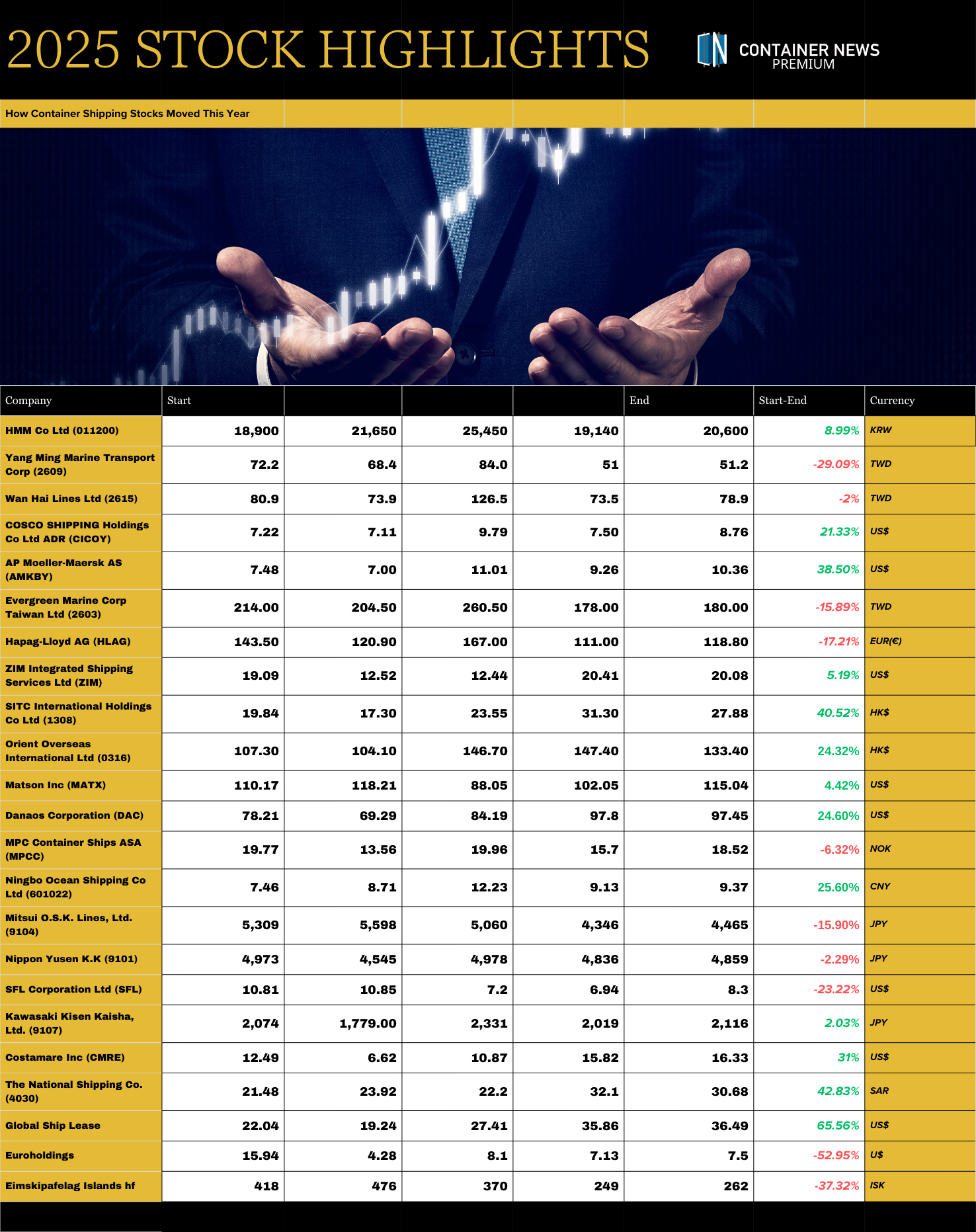
Asian Market Strength and Mid-Year Peaks
Asian carriers experienced the most dramatic movements in 2025. Most major companies posted powerful mid-year gains driven by recovering export volumes and strong demand across trans-Pacific and intra-Asia trade lanes. However, after peaking in the middle of the year, many of those gains softened during the second half, especially as freight rates normalized and investor sentiment turned more cautious.
Some carriers held part of their gains into late Q4, while others ended the year close to or even below their starting levels. The Asian market proved highly sensitive to rate cycles, delivering the strongest rallies and also some of the sharpest pullbacks.

Europe: Early Strength and Late-Year Cooling
European container carriers benefited from solid early-year freight levels and strong contract coverage, resulting in a healthy performance during the first half of the year. As the year progressed, consumer imports slowed and manufacturing softened, creating late-year price pressure for several European operators.
Unlike Asia, European price movements were less explosive, with fewer large surges but clear late-year moderation as the regional economy weakened and spot market conditions eased.
North America and Leasing Companies: Weak Patches, Then Strong Finishes
North American operators and leasing-focused firms produced some of the most resilient late-year performances. Early in the year, several companies dealt with softer sentiment, yet as vessel utilization strengthened and charter demand tightened, prices moved meaningfully higher into Q4.
The leasing segment benefited from limited fleet renewal, strong contract coverage and tight vessel supply, helping companies maintain or grow valuation even when spot freight conditions were mixed. These firms showed that predictable earnings and charter security offer stability in a normalized freight environment.
Japan: Mild Movements and Predictable Stability
Japanese container and logistics operators demonstrated exceptionally low volatility compared with the rest of the world. Their price movements followed a gradual arc rather than sharp spikes, reflecting long-term contract exposure, diversified revenue streams and strong energy-transport integration.
These carriers did not experience dramatic rallies or collapses. Instead, they moved steadily and predictably, confirming that diversification and contract strength are powerful stabilizers in cyclical markets.
Middle East: Structural Growth With Limited Drawdowns
One of the clearest upward trends came from the Middle East, led by a major Saudi carrier. Unlike other regions that experienced strong rallies followed by corrections, the Middle Eastern market advanced steadily through the year with limited late-year weakness.
This reflects the region’s expanding role as a strategic logistics and energy corridor, growing port capacity, and diversified cargo flows. The Gulf continued to strengthen as a regional hub, attracting both containerized trade and long-term investment interest.
Smaller and Niche Operators: More Volatile and Region-Sensitive
Smaller and niche container operators experienced more pronounced swings, with periods of rapid gains followed by equally rapid declines. Performance depended heavily on local trade conditions, specialized cargo cycles and spot market swings, making these companies more exposed to short-term sentiment than large global carriers.

This segment served as a useful indicator of local market health and short-term rate conditions, showing clear fluctuations throughout the year.
Market Themes and Strategic Outlook
2025 container market reveal several clear global patterns emerged. The strongest overall period for the industry was the second quarter, when Asia led an international surge in manufacturing output and freight movement.
European companies delivered robust early-year pricing but eased into late Q4 as consumer activity softened. North American leasing operators and charter-focused firms excelled in late-year conditions as utilization rose and vessel scarcity continued to support charter values. Japanese companies demonstrated exceptional stability due to diversified revenue structures and insulated contract exposure.
The Middle East emerged as a strategic growth region, reflecting rising logistics capacity and energy-linked expansion.
The 2025 container market confirms that normalized freight conditions have not weakened long-term sector fundamentals. Instead, pricing movements increasingly reward operational diversification, charter longevity, tonnage scarcity and strategic regional positioning rather than pure dependence on volatile spot freight rates.
The industry now appears healthier, more predictable and structurally more balanced than at any point since the pandemic boom. The companies that outperformed were those with strong contract coverage, diversified revenue streams, or access to high-growth regional corridors.
The post 2025 container market review appeared first on Container News.
Content Original Link:
" target="_blank">


